

Baby-Soft Skin: The Science Behind It and What Changes as We Age
Baby skin feels soft because it contains proportionally higher levels of natural moisturising factors, near-perfect barrier function, and abundant hyaluronic acid throughout the dermis. As we age, all three decline: natural moisturising factor production decreases, barrier function becomes more easily disrupted, and hyaluronic acid levels in the skin drop significantly. The two-step approach, humectant on damp skin followed by an occlusive seal, addresses all three by externally replacing what the skin produces less of naturally.
"I just want my skin to feel like it did when I was young." It is one of the most common things said about skin, and it is actually a very specific and achievable goal once you understand what baby skin is doing differently.
The softness is not random. It is the result of three measurable biological conditions. Understanding those conditions makes it much easier to know what a skincare routine needs to do, and what it actually cannot do.
What baby skin is actually doing
Condition one: high natural moisturising factor
Natural moisturising factor (NMF) is a collection of water-attracting compounds that sit within the outer skin cells themselves. The primary components include amino acids, urocanic acid, pyrrolidone carboxylic acid, and lactic acid. Together they act as the skin's internal humectant system, drawing water into the skin cells from the environment and from the layers below.
Infant and young child skin has proportionally high levels of NMF. The outer layer of skin is well-hydrated not because water is being applied to it constantly, but because the skin is actively pulling and holding water within its own structure. Transepidermal water loss is low. The skin plumps rather than deflates.
As we age, NMF production declines. The decline accelerates with prolonged sun exposure, with harsh cleansers that strip the outer layer, and with the hormonal shifts of perimenopause, all of which affect the skin's ability to maintain its own internal water supply.
Condition two: intact barrier function
The skin barrier in infancy is not fully mature at birth (which is why newborns need careful skin care), but by the toddler years it is highly functional. The lipid matrix between skin cells, primarily ceramides, cholesterol, and fatty acids, forms a near-watertight layer that prevents water loss and blocks irritants.
An intact barrier is the foundation of all the other properties associated with soft, healthy-feeling skin. Without it, even well-hydrated skin feels rough, reactive, or tight. Barrier function declines with age, and more sharply in perimenopausal skin where oestrogen, which supports ceramide production, is reducing. [2]
Condition three: abundant dermal hyaluronic acid
Hyaluronic acid is a naturally occurring molecule found throughout the body, but it is particularly concentrated in the skin. A single molecule can hold up to 1,000 times its weight in water. In young skin, it is present at high levels throughout the dermis, contributing to the plump, bouncy texture that reads as "soft." [1]
By the mid-forties, dermal hyaluronic acid levels have declined measurably, and the rate of decline accelerates around perimenopause. The skin loses some of its internal water-holding architecture. The result is skin that looks and feels less full, less resilient, and more prone to surface dryness than it did a decade earlier.
What skincare can and cannot do about this
This is where the science becomes practical. Applied skincare cannot reverse the cellular changes that happen with age, and TGA guidelines in Australia appropriately prevent cosmetic products from claiming to do so. But applied skincare can do something genuinely useful: it can externally supplement what the skin is producing less of internally.
Topically applied hyaluronic acid does not penetrate deeply enough to replenish dermal HA stores, but it does hydrate the outer layers of skin very effectively. [1] Applied to damp skin, it mimics part of the function of natural moisturising factor: it pulls water in and holds it at the surface. Skin that would otherwise feel dry and tight within an hour of washing feels comfortable for hours.
A Hyaluronic Acid Serum with multiple molecular weights reaches different depths of the outer skin layers, giving a more complete hydration effect than a single-weight formula. Applied to damp skin, then sealed with a moisturiser, it creates a temporary external version of what baby skin does internally.
Topically applied hyaluronic acid has demonstrated significant improvements in skin hydration, elasticity, and surface smoothness in clinical assessments. The efficacy appears influenced by molecular weight, with low-molecular-weight forms showing deeper penetration into the stratum corneum.Bukhari et al. (2018) [1]
The two-step principle: hydration then occlusion
Baby skin does not require a two-step routine because it manages both hydration and occlusion internally. Adult skin, particularly from the forties onward, often needs external support for both functions.
Hydration refers to water content in the skin cells themselves. Occlusion refers to sealing the skin surface so that water does not evaporate before the cells can use it. A humectant like hyaluronic acid addresses hydration. A moisturiser or facial oil addresses occlusion.
Used alone, each is less effective than the two used together. A humectant without an occlusive layer pulls water in but cannot prevent it from evaporating. An occlusive layer without a humectant underneath seals in whatever water is present, which in depleted skin may not be enough to make a meaningful difference.

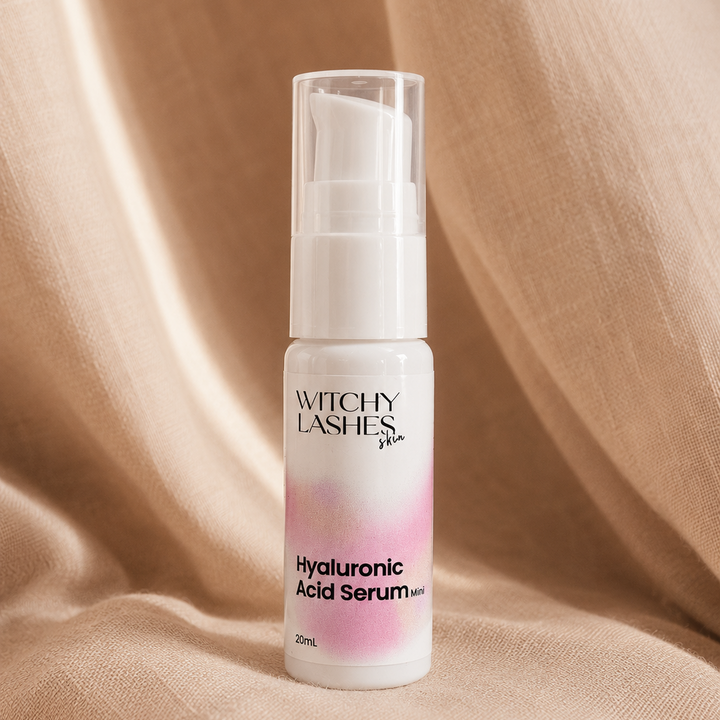
Witchy Lashes Hyaluronic Acid Serum
Three molecular weights of hyaluronic acid, formulated for application to damp skin. No fragrance, no alcohol, no occlusive heaviness. The hydration step before your moisturiser.
See the Hyaluronic Acid SerumWhat affects how quickly this works
Several factors influence how quickly skin responds to a consistent two-step routine:
Starting skin condition
Skin that has been consistently under-hydrated for months or years takes longer to respond than skin that is simply missing one step. The outer layers need time to rebuild their water content at baseline before the effects become consistently visible and tactile.
Cleanser choice
A cleanser that strips the barrier lipids daily counteracts the work of the hydration routine. If the routine is improving but not dramatically, the cleanser is worth assessing. Squeaky-clean is the wrong target for barrier-sensitive skin.
Environmental factors
High UV exposure accelerates the degradation of hyaluronic acid in skin tissue. Daily SPF is the single most evidence-supported intervention for preserving skin hydration over time. [2] In Australia, where UV levels are among the highest in the world, SPF use has a meaningful effect on how skin ages and how it holds water.
Hormonal context
For women in perimenopause, declining oestrogen is reducing the skin's own output of NMF components, hyaluronic acid, and barrier lipids simultaneously. External supplementation via a consistent routine helps, but the baseline is shifting. This is why a routine that "worked" at thirty-five may need adjustment in the mid-forties, not because the products failed, but because the skin's needs changed. The external routine needs to work harder to compensate for what the internal system is producing less of.
For the evening seal, a few drops of Blue Tansy Calming Facial Oil pressed over the moisturiser provides an additional occlusive layer that slows overnight water loss, one of the longer windows when the skin can lose hydration without any replenishment.
"The goal is not to make your skin behave like a twenty-year-old's. The goal is to give it the external support it needs now."
This article addresses normal age-related changes in skin hydration and texture. Skin conditions including eczema, psoriasis, rosacea, and perioral dermatitis involve different mechanisms and often require different treatment. If your skin changes are severe, rapidly worsening, accompanied by redness, bumps, or flaking that does not resolve with a gentle routine, see your GP or a dermatologist. For perimenopause questions beyond skin, the Australian Menopause Society's find-a-doctor tool is at menopause.org.au.

When I was formulating the serum, I spent a long time thinking about molecular weight. Most single-HA serums use one weight. The problem is that different sizes do different jobs: larger molecules sit at the surface and prevent water loss, smaller ones reach deeper into the stratum corneum. Three weights was a deliberate choice, not a marketing one.
The Renewal Ritual pairs the serum with the Blue Tansy oil because hydration without occlusion is only half the job. That two-step combination is the closest external approximation I know of to what baby skin manages internally.
Marcha, founder of Witchy Lashes
Common questions
Can I actually get baby-soft skin as an adult?
The softness of baby skin comes from specific biological conditions, high natural moisturising factors, intact barrier function, and abundant hyaluronic acid, that decline with age. Skincare cannot fully replicate those internal conditions, but it can externally supplement them. A consistent humectant and occlusive routine can produce skin that feels genuinely softer and more comfortable, even if the underlying biology has changed. The goal is optimising what your skin can do now, not restoring it to a previous state.
Does hyaluronic acid actually penetrate the skin?
It depends on molecular weight. High-molecular-weight hyaluronic acid (the most common form) sits at the skin surface, forming a film that attracts and holds water. Low-molecular-weight forms have been shown in laboratory studies to penetrate into the outer layers of the stratum corneum more deeply, improving hydration at a slightly deeper level. Neither form reaches the dermis in meaningful quantities via topical application. The surface-level effect, however, is well-documented and produces noticeable improvements in skin comfort and texture.
Why does hyaluronic acid serum sometimes make skin feel drier?
This happens when hyaluronic acid is applied to dry skin in a dry environment. Hyaluronic acid is a humectant: it draws water from wherever it can find it. Applied to dry skin in low-humidity conditions, it can draw water upward from the deeper skin layers and then allow it to evaporate at the surface, leaving skin feeling drier than before. The fix is: apply to damp skin (just after rinsing, while still visibly moist), and seal with a moisturiser immediately after. This keeps the humectant working in the right direction.
What is natural moisturising factor and can I restore it?
Natural moisturising factor (NMF) is a group of water-attracting compounds inside the skin cells of the outer skin layer. It includes amino acids, urocanic acid, pyrrolidone carboxylic acid, and lactic acid. NMF is produced naturally and declines with age, UV damage, and harsh cleansing. You cannot directly "restore" NMF via topical products, but you can support its preservation by avoiding harsh cleansers, protecting skin with daily SPF, and maintaining barrier function. Skincare containing amino acids, lactic acid, or urea provides some external NMF-like function at the skin surface.
Do I need a different routine for morning and evening?
The morning routine and evening routine share the same foundation (humectant on damp skin, then seal) but differ in two ways. Morning: finish with SPF over your moisturiser. This is non-negotiable in Australia. Evening: you can use a heavier occlusive step, such as a facial oil, because there is no SPF sitting on top of it and your skin has six to eight hours of uninterrupted recovery time. The evening occlusive step is where a facial oil is particularly useful: it provides a seal that lasts through the night without interfering with daytime SPF application.
How long before I notice a difference in skin softness?
Surface softness can improve within a few uses of a consistent humectant-plus-seal routine. Skin comfort (less tightness, less reactivity) often stabilises within one to two weeks. More visible improvements in texture and tone take longer, typically four to six weeks, because that reflects one full skin cell cycle. Improvements related to hormonal changes are slower and more variable. Consistency matters more than any single product choice.
The Renewal Ritual
Hyaluronic Acid Serum for the hydration step. Blue Tansy Calming Facial Oil to seal. The external equivalent of what baby skin manages internally.
Related reading
References
- Bukhari, S. N. A., Roswandi, N. L., Waqas, M., Habib, H., Hussain, F., Khan, S., Sohail, M., Ramli, N. A., Thu, H. E., & Hussain, Z. (2018). Hyaluronic acid, a promising skin rejuvenating biomedicine: A review of recent updates and pre-clinical and clinical investigations on cosmetic and nutricosmetic effects. International Journal of Biological Macromolecules, 120(B), 1682–1695.
- Lephart, E. D., & Naftolin, F. (2022). Menopause and the skin: old favorites and new innovations in cosmeceuticals for estrogen-deficient skin. Dermatology and Therapy, 11(1), 53–69.

