

The short answer
If you have started noticing your skin looking crepey, dull or textured in ways your usual moisturiser does not really touch, you are noticing something real.
These changes are among the most common reasons women in their forties, fifties and sixties start looking at their skincare routine and thinking, something has shifted. The useful part is that the biology underneath is well understood. The slightly less convenient part is that these changes are not usually a simple hydration problem. More moisturiser may make the skin feel better for a while, but it usually will not address the whole picture, because some of the change is happening underneath the moisturising layer.
In plain English, a few things are happening together. Your skin's collagen production has slowed. Your skin's own hyaluronic acid production has reduced. Cell turnover has slowed. Years of accumulated UV exposure are showing in the way light catches the skin. These shifts create the appearance changes you are seeing, and they explain why a moisturiser alone, however lovely, can start to feel like it is not enough.
The routine that supports these changes has three components, each doing a different job.
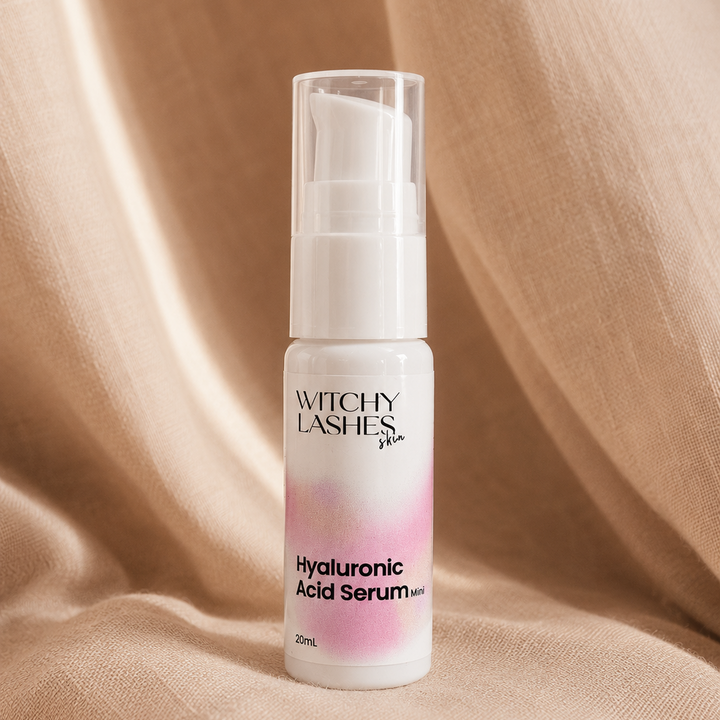
Hydration, to replace some of the water your skin no longer holds as easily as it used to. This is what a hyaluronic acid serum is for, on damp skin, twice a day.
Calming and barrier support, to help your skin keep that water there and feel more comfortable. This is what a calming facial oil is for, layered over the hyaluronic acid.
Renewal-pathway support, to gently support the look of fine lines, texture and tone over time. This is what a vitamin A product is for, used in the evening, two to five nights a week depending on tolerance.
Together, these three jobs become the Witchy three-product routine: the Hyaluronic Acid Serum, the Blue Tansy Calming Facial Oil, and the Retinyl Renewal Oil. The three are designed to work together for the kind of skin most likely to be reading this article. If you would like the three products together, our Witchy Skin starter set brings them into one routine.
This article walks through what crepey, dull and textured skin actually mean, why they happen, what helps and what does not, and how the three pillars of the routine work together.

What "crepey", "dull" and "textured" actually mean
These three words get used a lot in skincare, often interchangeably and often loosely. Each describes something slightly different. Knowing the difference helps you choose the right support.
Crepey skin. Skin that looks slightly creased, slightly papery, with fine lines that read more clearly than they used to, especially in areas of thinner skin: under the eyes, the neck, the chest, sometimes around the mouth. The creping is not the deep folds of established wrinkles. It is the finer, lighter, almost tissue-like texture that becomes more visible when skin is dehydrated, when it has lost some of its underlying structural support, or both.
Crepey skin is often a combined story of three things. First, the look of skin that is dehydrated in the upper layer. Second, the look of reduced collagen and elastin in the underlying tissue. Third, the look of accumulated UV exposure changing the elastic fibres in the skin (Fisher et al., New England Journal of Medicine, 1997).
Dull skin. Skin that has lost some of its light-reflecting quality. Where younger skin tends to look slightly luminous, dull skin reads flatter, sometimes greyer, sometimes more yellow. The colour is not necessarily different. The way light bounces off the surface is.
Dull skin is usually a story of slower cell turnover (the surface is holding more cells that should have already shed), reduced internal hydration, and sometimes pigmentation patterns that have developed over years. The surface is rougher at a microscopic level than younger skin, so light scatters rather than reflects.
Textured skin. Skin where the surface looks uneven in light. Small bumps, slight roughness, fine lines that show up more in certain lighting, patches that catch the light differently. This is different from active conditions (acne, milia, keratosis pilaris), although those can contribute. Textured skin is more about the cumulative effect of slower cell turnover, sun damage, and changes in the deeper skin structure.
Most women experiencing these changes have some combination of all three, not just one. The biology underneath them overlaps. The skincare response overlaps too.
What is actually happening underneath
The visible changes have a biological story. Understanding the story helps you understand why a moisturiser alone does not address it.
Collagen production slows. From around age twenty-five, the skin's fibroblasts (the cells that make collagen) gradually slow their production. The pace picks up significantly in perimenopause and menopause, with most women losing around thirty per cent of their skin collagen in the first five years after menopause. Collagen is the main structural protein of the skin. As it reduces, the skin has less internal scaffolding, which contributes to the look of thinner-feeling, more crepey-looking skin.
Elastic fibres change. UV exposure damages the elastin fibres in the skin over years. This is a process called solar elastosis, where the elastic fibres become disorganised and lose their snap. It is one of the main biological drivers of the look of cumulatively sun-aged skin, and it is largely irreversible at the structural level (Fisher et al., New England Journal of Medicine, 1997).
Endogenous hyaluronic acid declines. Your skin makes its own hyaluronic acid. This production reduces measurably with age and with hormonal change. A 2022 paper in Aesthetic Surgery Journal (Lephart and Naftolin) reviewed how endogenous hyaluronic acid declines through perimenopause and menopause, and how this contributes to the look of skin that holds water less well than it used to.
Cell turnover slows. Younger skin renews its top layer roughly every twenty-eight days. Older skin can take forty days or longer. Slower turnover means more cells stay on the surface for longer, contributing to the look of dullness and the look of textured skin.
Sebum production reduces. From your late thirties onward, your skin's own oil production declines. The lipid layer that holds water in becomes thinner. This compounds the hydration story: less internal water production, less oil to hold the water you do have.
Cumulative UV exposure shows. Years of UV exposure produce pigmentation patterns (sun spots, melasma, uneven tone), thickened-looking skin in some areas, thinned-looking skin in others, and the textural changes of photoageing.
This is the underlying picture. Crepey, dull and textured skin are not a single problem. They are the visible expression of several biological changes happening at once.
Why "just moisturise" stops being enough
A moisturiser does specific things. It softens the surface of the skin. It can reduce transepidermal water loss. It can deliver some emollient ingredients to the upper skin layer. It can provide a temporary improvement in the look and feel of dryness.
What a moisturiser cannot do, no matter how expensive or well-formulated, is reach the layers of the skin where collagen, elastin, and cellular turnover are happening. Moisturisers work at the surface. The changes that drive the look of crepey, dull and textured skin are happening deeper.
This is why so many women in their forties and fifties have the experience of trying a richer moisturiser, or a different moisturiser, or a more expensive moisturiser, and finding that nothing quite hits the mark. The moisturiser is doing what moisturisers do. It is just not the right tool for the job.
The right tools, all three of them, are different.
What actually helps
The routine that supports the visible changes has three components. Each does a different job. Together, they support the appearance of skin that is crepey, dull or textured.
Hydration: replacing the water your skin no longer makes as well
The first job is putting water into the upper layer of your skin, and keeping it there.
Hyaluronic acid is the most studied humectant in skincare. It can bind up to a thousand times its weight in water, and when applied to damp skin, it draws water into the upper skin layer and holds it there. Research has shown that topical hyaluronic acid improves measured hydration in skin and supports the appearance of plumper, more comfortable skin (Bukhari et al., International Journal of Biological Macromolecules, 2023).
The Witchy Hyaluronic Acid Serum is a three-ingredient formula: purified water, plant-based hyaluronic acid, and a touch of natural preservation. No fragrance, no essential oils, no actives. Used on damp skin within sixty seconds of cleansing, twice a day, it provides the water-in step that supports the look of fuller, less crepey, less drawn-looking skin.
This is the first piece. It is the foundation that the rest of the routine sits on.
Calming and barrier support: holding the water there
Hydration alone is not enough. The water you have just put into your skin will leave again, often faster than you would think, especially in a climate as drying as Australian indoor air-conditioning.
The seal step is what holds the water in. A facial oil with the right botanical profile contains fatty acids that support the skin's lipid layer, antioxidant compounds that protect against environmental stressors, and components studied for calming and antioxidant activity that support a calm baseline.
The Witchy Blue Tansy Calming Facial Oil contains blue tansy essential oil with its characteristic chamazulene content. Chamazulene has documented anti-inflammatory and antioxidant effects in laboratory studies (Slon et al., Molecules, 2024; Lairikyengbam et al., International Journal of Molecular Sciences, 2024). The oil supports a calm, comfortable skin baseline alongside its seal function.
For dull-looking skin in particular, the layered effect of hyaluronic acid on damp skin sealed with a facial oil tends to produce a noticeable improvement in the look of luminosity within the first weeks of consistent use. The hydration is fuller. The light bounces off the surface differently. The skin reads as more comfortable.
This is the second piece. Together with the hydration, it is the calm baseline routine.
Renewal-pathway support: the part that addresses the deeper biology
The third piece is the one that reaches past hydration and into the deeper biology of skin renewal.
Vitamin A is the most studied skincare ingredient in dermatology. Research has shown that retinoids, after conversion to retinoic acid in the skin, bind to retinoid receptors and influence the genes that control cell proliferation, collagen synthesis support, and the look of skin that has been through photoageing (Sorg et al., Dermatologic Therapy, 2006; Mukherjee et al., Clinical Interventions in Aging, 2006). The 2023 Shu et al. paper specifically examined retinyl palmitate and showed reductions in UVB-induced collagen degradation, reductions in inflammatory markers, and improvements in the appearance of wrinkles and erythema in laboratory models.
This is the ingredient that supports the renewal-pathway side of the story. Hydration alone cannot do this. A calming oil alone cannot do this. The vitamin A pathway is the one that most often supports the underlying biology of crepey, dull, textured skin.
The Witchy Retinyl Renewal Oil uses retinyl palmitate, the gentlest cosmetic form of vitamin A. It is the form most likely to be tolerated consistently over the long haul, which matters because vitamin A works through accumulation over months. A retinoid used four nights a week for a year does more for the appearance of fine lines, texture and tone than a stronger retinoid used three weeks before reacting and stopping.
This is the third piece. Used two to five evenings a week on damp skin under the hyaluronic acid serum, with the calming facial oil holding the off-night routine, the retinyl palmitate provides the renewal-pathway support that hydration and calming cannot reach on their own.
A supporting ingredient worth knowing about: niacinamide
We do not currently make a niacinamide product, but for completeness it is worth knowing what this ingredient does, because some women may want to add it to a wider routine.
Niacinamide (vitamin B3) has strong evidence for improvements in the appearance of fine lines, skin tone evenness, hyperpigmentation, and barrier function (Bissett et al., Dermatologic Surgery, 2005; Hakozaki et al., British Journal of Dermatology, 2002). It is well-tolerated, pairs well with retinoids, and can reduce some of the early reactivity of retinoid introduction (Fu et al., British Journal of Dermatology, 2010).
If you want to add a niacinamide product to the routine, do so in the morning, or on calming evenings rather than retinoid evenings, to avoid stacking too many actives at once.
How the three pieces work together
The architecture of the routine is what makes it work.
Morning, every day
- Gentle cleanse or rinse with cool to lukewarm water.
- Pat skin damp, not dry.
- Within sixty seconds, press in a few drops of Hyaluronic Acid Serum.
- Wait about thirty seconds.
- Press in a few drops of Blue Tansy Calming Facial Oil.
- Mineral sunscreen as the final step.
Retinoid evenings (two to five per week, depending on tolerance)
- Cleanse gently.
- Pat damp.
- Hyaluronic acid serum within sixty seconds.
- Wait thirty seconds.
- Two to three drops of Retinyl Renewal Oil on top.
- Nothing else.
Calming evenings (the rest of the week)
- Cleanse gently.
- Pat damp.
- Hyaluronic acid serum within sixty seconds.
- Wait thirty seconds.
- Three to four drops of blue tansy calming facial oil on top.
That is the complete routine. Three products. Different jobs. Same skin.
The architecture matters because each piece does something the others cannot. Hydration alone leaves the water unprotected. Calming alone does not put new water in or address the renewal pathway. Vitamin A alone leaves the surface dry and the barrier fragile. Together, the three pieces produce a routine that addresses the look of crepey, dull and textured skin from three angles at once.
If you are new to retinoids, start with the hyaluronic acid serum and calming oil for two weeks first, then introduce the retinyl renewal oil at twice a week and build gradually.
What to expect, realistically
The most honest thing we can tell you about realistic results is that they are slower than skincare marketing suggests, and they are real.
For most women starting this three-product routine, here is the rough curve.
Weeks one to four. The hydration and calming components produce the first visible change. Skin tends to look more comfortable, less drawn, slightly more luminous. The look of dullness often improves first because the immediate hydration story is what addresses it most directly. The retinoid is still in its introduction phase, doing little visible work yet.
Weeks four to twelve. The retinoid component starts producing its first visible effects. Fine lines may look slightly softer when light catches them. The look of texture may begin to improve in certain areas. Makeup may sit slightly better. These are subtle. They are early signs.
Months three to six. The cumulative effect becomes clearer. The look of crepey skin, especially in areas of thinner tissue, often shows the most clear improvement here. Tone may look more even. The skin reads as fuller, calmer, more even in light.
Months six to twelve. The full cumulative effect of consistent retinoid use, combined with consistent hydration and calming, usually shows. The change is rarely dramatic in a single moment. It is the kind of change you might see comparing a photograph from a year ago.
This is the realistic curve. Skincare marketing often promises faster, more dramatic outcomes. The dermatology literature consistently supports slower, more cumulative results.
When this is not the right routine
There are situations where the three-product routine, or the retinoid component specifically, is not the most helpful answer.
During pregnancy or breastfeeding, no retinoid is recommended. The Hyaluronic Acid Serum on damp skin, sealed with a fragrance-free moisturiser, is a calmer option. The Blue Tansy Calming Facial Oil contains essential oils which we do not recommend in this window.
During active cancer treatment, speak with your treating clinician before adding any retinoid.
During an active flare of eczema, perioral dermatitis or rosacea, hold the retinoid until the flare has settled. The hyaluronic acid and calming oil can continue, but speak with your GP if you are unsure.
During in-clinic procedure recovery, follow your clinician's specific aftercare timeline.
If you are using prescription retinoids, do not add a cosmetic vitamin A product without speaking to your prescribing doctor.
If your concerns are deep wrinkles, established melasma, or significant photodamage, a dermatologist may have options that are more direct than cosmetic skincare can offer. Cosmetic retinoids can support the appearance of fine lines and texture but are not a substitute for medical-grade interventions for more pronounced concerns.
If you have a suspicious mole, persistent skin change, or anything that does not look like ageing, see a GP. Skin cancer screening is not the territory of cosmetic skincare, and Australia has one of the highest skin cancer rates in the world. The annual skin check is a more important thing than any moisturiser.
healthdirect.gov.au has plain-English guides on most of these situations. The Australasian College of Dermatologists A-Z of Skin is the AU specialist resource and includes find-a-dermatologist tools.
I am not the right person to diagnose any of those situations.
I am the right person to write the calm, evidence-led routine and point clearly to a doctor when one is what you need.
FAQ
What causes crepey skin?
Crepey skin is the appearance change that comes from a combination of dehydration in the upper skin layer, reduced underlying collagen and elastin support, and the structural changes that follow years of UV exposure. It is most visible in areas of thinner skin: under the eyes, around the mouth, the neck, the chest. Moisturiser alone cannot address it because the biology is happening below the moisturising layer. A routine that combines hydration, barrier support and vitamin A pathway support is the more direct approach.
Can crepey skin be reversed?
Some appearance changes can be improved, others cannot. The look of dehydration-driven crepeyness usually responds well to a consistent hydration and barrier routine within weeks. The look of reduced collagen and elastin support responds more slowly, over months, to vitamin A pathway support. The structural changes of accumulated UV damage (solar elastosis) are not fully reversible at the structural level (Fisher et al., 1997), but the surface appearance can usually be supported with a consistent routine. Realistic expectations are months to years, not weeks.
What causes dull skin?
Dull skin is usually a combination of slower cell turnover (cells staying on the surface longer than they did when you were younger), reduced internal hydration, sometimes underlying pigmentation changes, and sometimes simply tired skin from poor sleep, stress, or seasonal effects. The look of dullness often improves quite quickly with a consistent hydration routine. The deeper renewal-pathway changes that contribute to dullness respond more slowly to consistent vitamin A use over months.
How do I get rid of textured skin?
The look of textured skin is usually a combination of slower cell turnover, accumulated UV exposure, and sometimes specific underlying changes (pigmentation, fine lines, very mild scarring). The routine that supports it is hydration on damp skin twice a day, calming barrier support, and consistent vitamin A use two to five evenings a week. Visible improvement in the appearance of texture usually takes three to six months of consistent routine, with clearer change at twelve months.
Is moisturiser enough for ageing skin?
For most ageing skin, no. Moisturiser does a useful job at the skin's surface, but the changes that produce the appearance of crepey, dull and textured skin happen in the deeper layers. A routine that combines hydration (a hyaluronic acid serum), barrier and calming support (a facial oil), and renewal-pathway support (a vitamin A product) supports the visible changes more directly than moisturiser alone.
Can I just use a richer moisturiser instead of a serum and oil?
You can, but you may not get the same results. A richer moisturiser sometimes seals the surface so heavily that it does not let the lower layers do what they need to do. The serum-then-oil approach allows the hyaluronic acid to bind water in the upper skin layer first, then the oil seals it in. The order matters more than the richness of any single product.
Do I need all three products to see results?
You will see some results from any one of the three. The hyaluronic acid serum alone often produces a visible improvement in the look of dullness and dehydration within weeks. The calming facial oil alone improves the look of dryness and the comfort of reactive skin. The retinyl renewal oil alone supports the look of fine lines and texture over months. The three together address the appearance of crepey, dull and textured skin from three angles at once, which is why we built the routine as a three-part architecture.
What if I have very sensitive skin?
Start with the hyaluronic acid serum and the calming facial oil only, for two to four weeks. Once your skin is in a comfortable baseline, introduce the retinyl renewal oil at once a week, evening only, on damp skin under the hyaluronic acid. Build very slowly. Most sensitive skin tolerates retinyl palmitate well with this approach, even when it has reacted to other retinoids in the past.
Will this routine work in my fifties or sixties?
Yes. The underlying biology this routine addresses is the same biology that drives most skin changes in the forties, fifties and sixties. The results may be more subtle than in younger skin, and the timeline may be longer, but the routine remains valid. Many of the women writing to Witchy in this season of life find the three-product architecture more sustainable than the routines they used in their twenties and thirties.

