

Why this article is careful about what it claims
Rosacea is a condition that deserves a doctor's eyes on it.
Rosacea has several subtypes, and they can need different treatments. Some respond well to topical treatments. Some need oral antibiotics. Some involve the eyes (ocular rosacea) and can affect vision if untreated. Some present with thickening of skin on the nose and chin. The wrong skincare on the wrong subtype can make things worse, not better.
Some of what looks like rosacea is actually something else: lupus, perioral dermatitis, contact dermatitis, photodermatitis, an allergic reaction, or the flush pattern of a hormonal shift. Several of these need very different treatment. Skincare cannot diagnose any of this.
What I can do is share what tends to be gentler for skin in this pattern, what tends to make things worse, and when to put the article down and go see a doctor.
When to see a GP this week, not next month
Please book in if any of these sound familiar: persistent redness across the central face (cheeks, nose, chin, forehead) that lasts months and does not settle with gentler skincare; visible small blood vessels on the cheeks or nose; small raised bumps or pus-filled spots in the central face area; a repeated flushing pattern in response to wine, hot drinks, hot food, hot showers, exercise, sun, stress or emotion; eye irritation alongside facial redness (grittiness, itchy lids, light sensitivity); a burning or stinging sensation that does not settle; skin that has been progressively worsening over six to twelve months; a family history of rosacea with similar symptoms; or thickening or texture changes on the nose or chin.
healthdirect.gov.au has a plain-English guide to rosacea and a registered nurse line on 1800 022 222. The Australasian College of Dermatologists A to Z of Skin has a find-a-dermatologist tool. A GP can usually start treatment while you wait for a dermatologist referral.
What skin that feels like rosacea usually looks like
The pattern most women describe sounds something like this: cheeks that flush with very little provocation; a general pink or red baseline that does not fully go away, even on calm days; skin that feels hot in the afternoon; reactivity to skincare you used to tolerate, especially fragranced products, retinol, acids and strong vitamin C; fine lines that look sharper when your skin is flushed; a vague, hard-to-name sense of skin "anger" that goes up and down with stress, climate and hormones.
If this sounds like you, the routine below may be useful regardless of whether you eventually get a diagnosis. Skin that flushes easily and reacts often needs the same kind of gentle support whether the underlying cause is genuine rosacea, perimenopause, a sensitised skin barrier, or a combination of all three.
The women I have seen do best in this situation are the ones who do two things at once. They book the doctor's appointment, and they simplify their skincare while they wait.
The gentle routine
The principle is simple. Less is more for redness-prone skin. Avoid anything that triggers further inflammation, support the skin barrier, replace water that has been lost, and protect from UV.
Morning
- Rinse with cool to lukewarm water, or use a gentle cream-based or oil-based cleanser. Skip foaming cleansers. Cool water only.
- Pat your face damp, very gently. No rubbing.
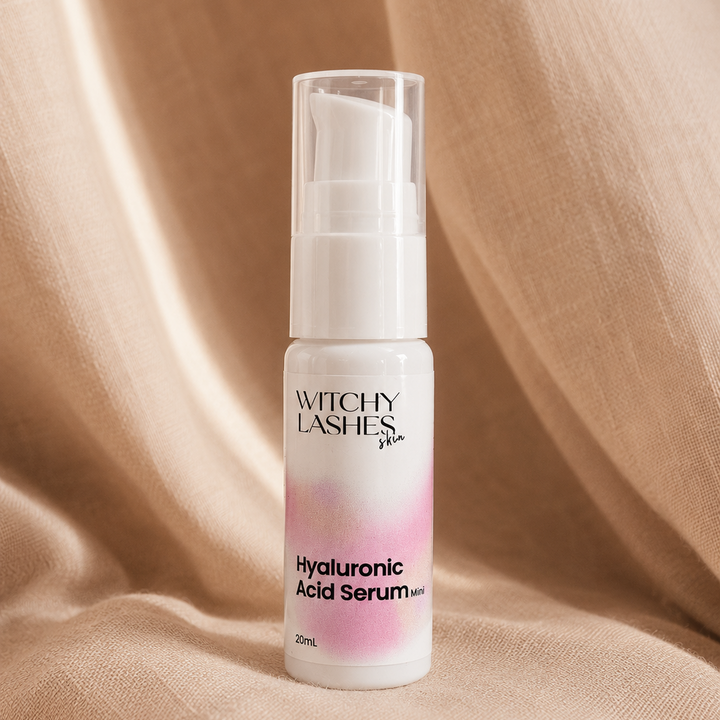
- Within sixty seconds, press in a few drops of Hyaluronic Acid Serum on damp skin. Hyaluronic acid is a humectant that binds water in the upper layer of skin and has been shown to improve hydration in topical applications (Bukhari et al., 2023). The Witchy serum is three ingredients: water, plant-based hyaluronic acid, and natural preservation. No fragrance, no essential oils, no actives that could aggravate reactive skin.
- Wait about thirty seconds.
- If your skin has tolerated facial oils in the past, press in two drops of Blue Tansy Calming Facial Oil over the top. The oil contains chamazulene, a compound with documented antioxidant effects in laboratory studies (Slon et al., 2024). If you have never used a botanical oil on flushing skin, patch test for forty-eight hours on the inner forearm first. If you have any active redness flare, are unsure, or have not yet seen a GP, hold the oil and use a fragrance-free moisturiser as the seal instead.
- Apply mineral sunscreen as your final step. Mineral sunscreens (zinc oxide, titanium dioxide) are generally better tolerated by reactive, flushing skin than chemical sunscreens.
Evening
- Cleanse gently.
- Pat damp.
- Serum within sixty seconds.
- Wait thirty seconds.
- Two to three drops of facial oil, or your fragrance-free moisturiser, over the top.
If you would like both products together, the Renewal Ritual brings them into one pairing. The hyaluronic acid serum on its own, sealed with a simple moisturiser, gives most of the calming-feeling benefit and is the safer starting point for skin that is in active flare or in the diagnostic window.
What to avoid
Skincare triggers:
- Fragranced products, including "natural" fragrance.
- Strong essential oils, especially in leave-on products.
- AHAs and BHAs, especially at higher percentages.
- Retinol and retinoids, unless prescribed and titrated carefully.
- Vitamin C in L-ascorbic acid form at higher percentages.
- Anything that tingles, stings or burns on application. For redness-prone skin, tingling is usually a sign of damage, not effectiveness.
- Scrubs, exfoliating cloths, brushes and harsh tools.
- Hot water on the face.
- Toners with alcohol.
Lifestyle triggers:
- Wine, especially red wine.
- Hot drinks (coffee, tea), especially in winter.
- Hot, spicy food.
- Hot showers, saunas, hot yoga.
- Direct sun exposure without sunscreen.
- Extreme temperature changes.
- Stress, lack of sleep, burnout.
- Hormonal shifts (perimenopause, postpartum).
Identifying which triggers affect you specifically is a useful exercise. Keep a simple diary for two weeks. Note when your skin flushes or feels worst. Patterns usually emerge quickly.
What helps, beyond skincare
For flushing-prone skin, the lifestyle support often matters more than the products.
- Cool environments. Cool showers, cool bedrooms, cool indoor temperatures where possible.
- Sun protection daily, year-round, including overcast days.
- A wide-brimmed hat in summer. Better than relying on sunscreen alone.
- Cooler drinks and food. Hot tea is one of the most common triggers.
- Less alcohol, particularly red wine.
- Lower stress where possible. Sleep, water, time outside, walks, connection.
- Avoiding facial saunas, steaming, microdermabrasion and aggressive treatments.
- Tracking your specific triggers and adjusting your life accordingly.
A note from Marcha
I want to be careful with this article because the women who reach for it are often in the middle of feeling frustrated and self-conscious about their skin.
I am not a dermatologist. I am not a GP. I am not the right person to tell you whether you have rosacea or something else. I am the right person to write honestly about what tends to help skin that feels reactive in this way, and where to look for the diagnosis I cannot give you.
What I will say, from years of correspondence, is that the women I have seen do best in this situation are the ones who do two things at once. They book the doctor's appointment, and they simplify their skincare while they wait. The diagnosis takes time. A GP can usually start treatment sooner than a dermatology referral. In the meantime, the routine I describe in this article will not harm you. It is the gentlest, most stripped-back version of a skincare routine I can offer.
But the routine is not the answer to the question your skin is asking. The answer to that question is a doctor. Please make the appointment.
Marcha, Founder of Witchy Lashes Skin
Common questions
How do I know if I have rosacea or just sensitive skin?
You do not. That is what a GP or dermatologist is for. Rosacea has specific diagnostic criteria, including persistent central facial redness, visible blood vessels, papules or pustules in the central face area, and sometimes ocular involvement. A doctor can diagnose it properly. Skincare cannot.
Can hyaluronic acid help rosacea?
Topical hyaluronic acid is well tolerated by most reactive and redness-prone skin, including skin that has been diagnosed with rosacea. As a humectant, it binds water in the upper layer of skin and has been shown to improve hydration in topical applications. It is not a treatment for rosacea itself. Use as part of a gentle routine, applied to damp skin within sixty seconds of cleansing.
Is Blue Tansy safe for rosacea?
Some women with rosacea-feeling skin tolerate Blue Tansy oil well, applied carefully over a humectant serum. Some do not. If your skin is in an active flare, if you have not yet seen a doctor, or if you have a known plant allergy, hold the oil and use a fragrance-free moisturiser as your seal instead. Patch test for forty-eight hours before applying to your face. If you have a diagnosed rosacea condition, ask your GP or dermatologist whether they are comfortable with a botanical oil in your routine.
What is the best moisturiser for rosacea?
There is no single "best" moisturiser. For most rosacea-feeling skin, the principle matters more than the product: fragrance-free, simple ingredient list, no essential oils unless tolerated, no actives. A humectant on damp skin sealed with a simple moisturiser works well. If you have diagnosed rosacea, your GP or dermatologist may recommend specific products that suit your subtype.
Can stress cause rosacea?
Stress does not cause rosacea, but it is one of the most common triggers for flares. Many women with rosacea-feeling skin notice their flushing pattern worsens during stressful periods. Lower cortisol and better sleep are part of every good rosacea care plan.
Does diet affect rosacea?
For many people, yes. Common dietary triggers include alcohol (especially red wine), hot drinks, spicy food, and sometimes specific foods that vary between people. Keeping a food diary for two to four weeks usually identifies your personal triggers.
Should I avoid all essential oils if I have rosacea-prone skin?
Not necessarily, but be cautious. Strong essential oils in leave-on products can trigger reactivity. Diluted essential oils in carefully formulated facial oils are usually tolerated better, but every skin is different. Patch test for forty-eight hours before introducing any essential-oil-containing product. If you have diagnosed rosacea that is in active flare, hold off until your doctor has it stable.
The simple pairing
The Renewal Ritual
The hyaluronic acid serum and the blue tansy facial oil, together. Water in, then sealed. Start with just the serum if your skin is in active flare; add the oil when your skin has settled and tolerated it.
-
 Hyaluronic Acid Serum
-
 Blue Tansy Calming Facial Oil
References
- Bukhari, S.N.A., Roswandi, N.L., Waqas, M., et al. (2023). Hyaluronic acid, a promising skin rejuvenating biomedicine: A review of recent updates and pre-clinical and clinical investigations. International Journal of Biological Macromolecules.
- Slon, K., et al. (2024). Chamazulene: antioxidant and anti-inflammatory properties in laboratory studies. Journal of Natural Products Research.

