

Why this article is careful
Eczema is one of those conditions where well-meaning skincare can accidentally make things harder.
The skin barrier in eczema is genuinely different. Atopic dermatitis involves a structural difference in the skin's barrier function. The skin loses water faster than usual, allergens and irritants get in more easily, and the immune system responds with inflammation. Products that other skin tolerates fine can cause flares in eczema-prone skin.
Essential oils, fragrances, and certain botanicals are common triggers. Many "natural" skincare products contain ingredients that can flare eczema. Just because a product is plant-based does not mean it is gentle. Blue Tansy is a good example: it has calming properties in many contexts and is also an essential oil, which some eczema-prone skin reacts to.
Steroid creams and other prescription treatments have specific use protocols. Mixing skincare with prescribed treatments needs care. So when this article describes a routine, it is for skin that feels eczema-prone in a calmer, between-flare period, with the explicit understanding that medical care is the first port of call for any active flare.
When to see a GP
Please book a GP appointment if any of the following apply: patches of skin that itch, weep, crack or bleed; patches that recur in the same areas (inside elbows, behind knees, on the face, eyelids or hands); the condition affects your sleep because of itch; a recurring pattern that has not been diagnosed; you are using over-the-counter hydrocortisone for more than a week or two; a personal or family history of eczema, asthma, hay fever or food allergies; skin that is infected (increased redness, warmth, pus or fever); or a flare that is worse than your previous baseline and is not settling.
Healthdirect has plain-English information on eczema. The Eczema Association of Australasia has Australian-specific resources, support groups and patient information. The Australasian College of Dermatologists A to Z of Skin has a find-a-dermatologist tool. Eczema responds well to proper clinical care. Skincare on its own is not a substitute for that.
What skin that feels eczema-prone tends to look like
You might recognise some of these: easily dry, especially in winter or after washing; occasionally itchy, especially at the end of the day or in bed at night; sometimes flaky in patches, particularly on the cheeks, eyelids, or near the eyebrows; reactive to fragranced products, harsh soaps or new ingredients; tighter in cold weather, air-conditioning or after hot showers; sensitive to wool, certain detergents or certain fabrics; a familiar pattern of flares and settling, even without obvious triggers; a family or personal history of allergies, asthma or hay fever.
If three or more of these resonate, you may be dealing with mild atopic dermatitis or eczema-prone skin even without a formal diagnosis. A GP can clarify it.
If I could only give one piece of advice in this whole article, it would be this: do not delay seeing a GP if your skin is flaring. The right clinical care can change how you experience your skin and your day-to-day life.
The everyday routine, when your skin is in a quieter window
If your skin is not currently in active flare, and you are managing eczema-prone skin in a quieter everyday way, here is what tends to work well.
The principle: eczema-prone skin barrier function is fragile. The job of an everyday routine is to support water retention, replace barrier lipids where possible, avoid known triggers (especially fragrance and harsh actives), and protect from environmental stress.
Morning
- Rinse your face with cool to lukewarm water, or use a gentle, fragrance-free cream-based cleanser. Avoid soap, foaming cleansers and anything with sulfates.
- Pat your face damp with a soft towel. Gentle.
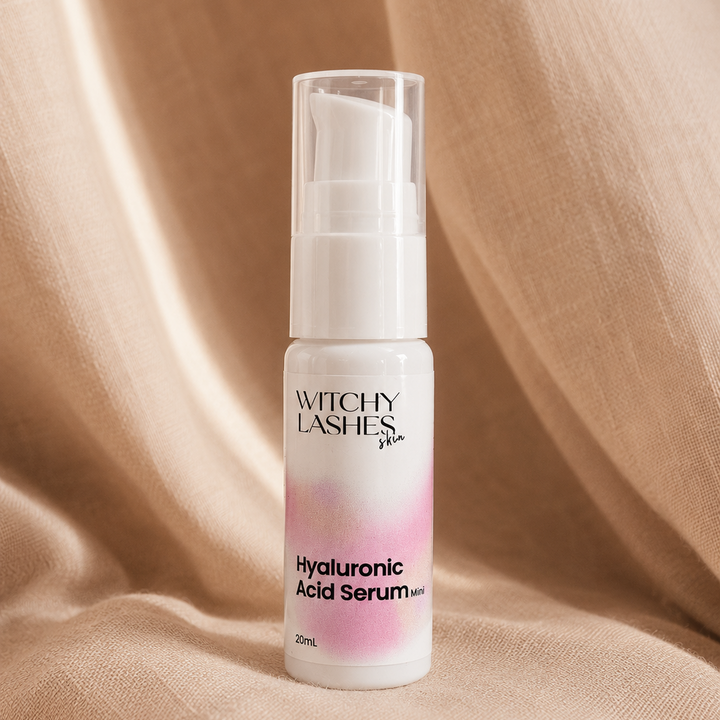
- Within sixty seconds, press in a few drops of Hyaluronic Acid Serum on damp skin. Hyaluronic acid is a humectant that binds water in the upper layer of skin and has been shown to improve hydration in topical applications (Bukhari et al., 2023). The Witchy serum is three ingredients: water, plant-based hyaluronic acid, and a touch of natural preservation. No fragrance, no essential oils, no actives. A very gentle hydrating step for eczema-prone-feeling skin.
- Wait about thirty seconds.
- If your skin is currently calm and tolerates oils well: press in two to three drops of Blue Tansy Calming Facial Oil, patch-tested first for forty-eight hours on the inner forearm. The oil contains chamazulene, a compound with documented antioxidant effects in laboratory studies (Slon et al., 2024), but it is also an essential-oil-containing product, and essential oils can trigger eczema flares in some people. If you have any current flare, any uncertainty, or have not patch tested: skip the oil and use a fragrance-free, dermatologist-recommended moisturiser as the seal instead (QV, Dermeze, Cetaphil, La Roche-Posay Lipikar, or whatever your GP has recommended).
- Apply mineral sunscreen as your final step.
Evening
- Cleanse gently.
- Pat damp.
- Hyaluronic acid serum within sixty seconds.
- Wait thirty seconds.
- The seal: facial oil if your skin tolerates it well, or your fragrance-free moisturiser.
For active flares: switch immediately to a fragrance-free, dermatologist-recommended cream and follow whatever your GP has prescribed. Hold the facial oil entirely. If you would like both products together for the quieter windows, the Renewal Ritual brings them into one pairing.
What to avoid
Skincare triggers:
- Fragrance, including "natural" fragrance.
- Strong essential oils in leave-on products.
- Soaps and foaming cleansers.
- Sulfates (SLS, SLES) in cleansers.
- AHAs and BHAs, especially during flares.
- Retinol and retinoids, unless your GP has prescribed and titrated.
- Anything that stings, burns or tingles on application.
- Hot water on the face.
- Heavily fragranced laundry detergent on bedding and towels.
Lifestyle triggers (vary between people):
- Hot showers, especially long ones.
- Wool and synthetic fabrics directly on the skin.
- Pet dander, dust mites, certain pollens.
- Heat and sweat.
- Stress and poor sleep.
- Sudden temperature changes.
- Chlorinated pools.
Keeping a simple trigger diary for two to four weeks can help identify your specific patterns.
Things that genuinely help eczema-prone skin
- Lukewarm, short showers rather than hot, long ones.
- Pat dry, not rub after washing.
- Apply moisturiser within sixty seconds of getting out of the shower, while skin is still damp.
- Fragrance-free everything, including laundry detergent, body wash, and household cleaners that touch skin.
- Cotton clothing and bedding where possible. Cotton sheets in particular.
- A humidifier in winter if you live somewhere with cold, dry indoor air.
- Manage stress in whatever realistic ways you can. Sleep, walks, connection, time outside.
- Identify your triggers and adjust where you can.
- See your GP regularly if you have a diagnosis, especially when starting or changing treatments.
A note from Marcha
I want to be careful with this article because the women who reach for it are often tired and frustrated.
Eczema-prone skin is exhausting in a way that other reactive skin patterns are not. The itch is real. The sleep disruption is real. The repeated cycle of flare, settle, flare, settle wears people down. The amount of skincare and home-life adjusting that goes into managing it is significant. None of this is in your head.
I am not a dermatologist. I am not an eczema specialist. I am not the right person to manage a flare or to guide treatment. I am the right person to write honestly about what tends to be gentle in everyday support for eczema-prone skin, and to point clearly to the medical and patient-community resources that can actually help.
If I could only give one piece of advice in this whole article, it would be this: do not delay seeing a GP if your skin is flaring. The right clinical care can change how you experience your skin and your day-to-day life. Skincare alone, however gentle, is not equivalent to that. The everyday routine in this article is for the quieter windows between flares. It is not a flare treatment.
The Eczema Association of Australasia is where I would point any woman writing in with this kind of question. The routine is the support. The medical care is the medicine. Please use both.
Marcha, Founder of Witchy Lashes Skin
Common questions
Is Blue Tansy good for eczema?
Not specifically, and please be careful. Blue Tansy contains essential oils, which can be a trigger for active eczema flares. During a flare, hold the oil and use just the Hyaluronic Acid Serum sealed with a fragrance-free moisturiser of your choice. In the quieter windows between flares, some eczema-prone skin tolerates Blue Tansy well, but patch test for forty-eight hours on the inner forearm first. If your GP or dermatologist has given specific product guidance, follow theirs.
Can hyaluronic acid help eczema?
Hyaluronic acid is well tolerated by most eczema-prone skin because it is a humectant with no fragrance or active ingredients. It binds water in the upper layer of skin and has been shown to improve hydration in topical applications, which can support skin barrier comfort in eczema-prone skin. It is not a treatment for eczema itself. For active flares, follow your GP's protocol; the hyaluronic acid serum can usually be used alongside prescribed treatments, but check with your doctor.
What is the best moisturiser for eczema?
There is no single "best" moisturiser, but for eczema-prone skin the principles are: fragrance-free, simple ingredient list, dermatologist-recommended for sensitive skin, and applied generously within sixty seconds of bathing. Common AU options include QV, Dermeze, Cetaphil and La Roche-Posay Lipikar. Your GP or dermatologist will have a specific recommendation that suits your skin.
Can stress cause eczema flares?
Yes, very commonly. Stress is one of the most reported flare triggers across eczema patient communities. Managing stress is part of every good eczema care plan, though it is not always possible to control. Sleep, time outside, walks and lower cortisol where you can find it all help.
Should I avoid all essential oils if my skin is eczema-prone?
For most eczema-prone skin, yes, especially during flares. Outside flares, some women tolerate diluted essential oils in carefully formulated products, but this varies between people. Patch test for forty-eight hours before introducing anything containing essential oils, watch for delayed reactions (which can appear days later), and have your GP's input if you are unsure.
Can I use sunscreen if I have eczema?
Yes, and it is important. Mineral sunscreens (zinc oxide, titanium dioxide) are generally better tolerated by eczema-prone skin than chemical sunscreens. Apply over your gentle skincare layer. If a sunscreen stings or causes a flare, switch to a different mineral formula or speak to your GP about options.
Will my eczema-prone skin ever go away?
For some people, yes. Childhood eczema often improves in adolescence or adulthood. For others, eczema is a lifelong pattern that needs ongoing gentle management. Either way, the right clinical care and consistent everyday care can usually keep skin in a much better baseline than it would be without them.
The simple pairing
The Renewal Ritual
The hyaluronic acid serum and the blue tansy facial oil, together. For the quieter windows between flares, when your skin is calm enough to try a carefully formulated oil over the serum.
-
 Hyaluronic Acid Serum
-
 Blue Tansy Calming Facial Oil
References
- Bukhari, S.N.A., Roswandi, N.L., Waqas, M., et al. (2023). Hyaluronic acid, a promising skin rejuvenating biomedicine: A review of recent updates and pre-clinical and clinical investigations. International Journal of Biological Macromolecules.
- Slon, K., et al. (2024). Chamazulene: antioxidant and anti-inflammatory properties in laboratory studies. Journal of Natural Products Research.

