

The short answer
If your skin has changed in your forties, you are not imagining it. The forties are when two separate transitions arrive at the same time: the cumulative effects of decades of life on your skin, and the beginning of the hormonal shift called perimenopause. Most of what you are noticing is a combination of both. Disentangling exactly which factor is causing which change is less useful than knowing that the approach that supports both is largely the same: gentler, more hydrating, more patient, with daily sunscreen carrying the heaviest load.
The two main drivers of skin change in your forties are the cumulative effects of decades of life on your skin (UV exposure, environmental load, the slow biology of ageing) and the beginning of perimenopause. Both are happening at the same time, and they produce overlapping changes that can be genuinely difficult to separate.
This guide exists to help you orient. If you are reading it because something has changed in your skin and you are trying to work out whether you are in perimenopause, whether what you are noticing is ageing, whether your routine needs to change, or whether you should see a doctor, you are in the right place.
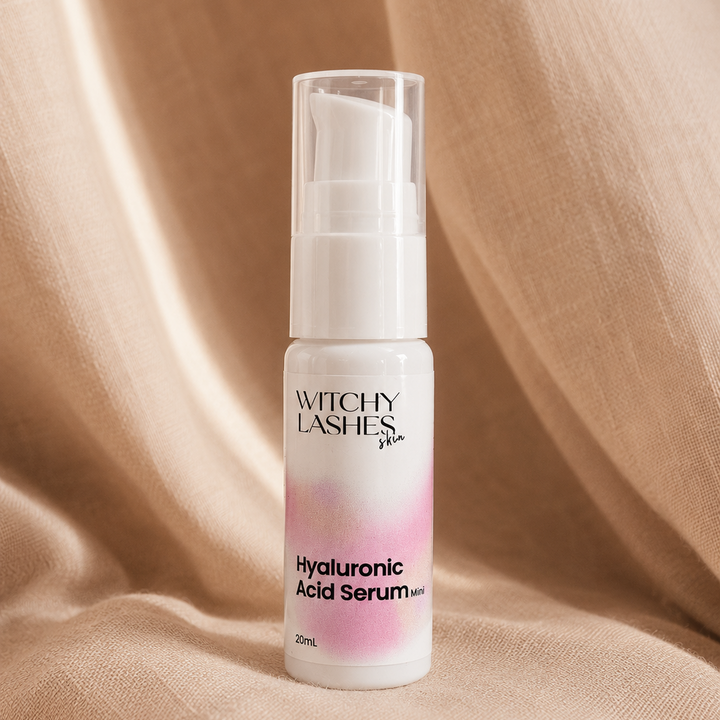
Witchy's three-product range was built for this combined picture. The Hyaluronic Acid Serum addresses the hydration changes. The Blue Tansy Calming Facial Oil addresses the more reactive baseline. The Retinyl Renewal Oil supports the gentle renewal that helps the visible cumulative changes. The rest of this guide walks through what is happening and what to do about it.
The two simultaneous transitions
Your forties involve two distinct biological changes happening at the same time, and most of what you are noticing in your skin is some combination of the two.
Cumulative ageing effects
Skin ageing has two components: intrinsic (the slow biological process that affects everyone over time) and extrinsic (the visible effects of UV exposure, environmental damage, lifestyle factors, and cumulative skin habits).
By the time you reach your forties, you have lived four decades with your skin. The intrinsic process has produced gradual changes happening since your twenties. Collagen synthesis has been slowing approximately 1% per year since around age twenty. Cell turnover, which renews your skin's outer layer roughly every twenty-eight days in your twenties, has gradually slowed. If you have spent significant time in the Australian sun, the cumulative UV exposure becomes more visible as cell turnover slows and older damaged layers persist at the surface longer.
This is general ageing, not specifically hormonal. It happens to all skin over time and is largely independent of perimenopause.
Perimenopausal hormonal change
Perimenopause is the years of hormonal transition before menopause. For most Australian women, it begins in the early to mid forties. The 2025 Australian Women's Midlife Years Study, published in The Lancet Diabetes and Endocrinology, surveyed more than 8,000 Australian women across the menopause transition and found that the average age of menopause is around 51, with perimenopause typically beginning four to eight years before that. [1]
"Oestrogen influences multiple skin functions directly, including collagen production, endogenous hyaluronic acid synthesis, sebum balance, barrier function, and melanocyte activity."
Lephart & Naftolin, Dermatology and Therapy, 2021 [2]The biology of perimenopause is dominated by fluctuating then declining oestrogen. This produces changes that often feel more pronounced, more sudden, and harder to predict than the gradual ageing that has been happening in the background.
The overlap
Where the two transitions overlap is what makes the forties confusing. Many of the changes you are noticing could be either ageing or perimenopause or both. Drier skin? Could be reduced sebum from ageing, reduced endogenous hyaluronic acid from perimenopause, or both. New fine lines? Cumulative collagen decline plus accelerated collagen loss from hormonal change. More reactive skin? General barrier ageing plus perimenopausal barrier changes.
The honest answer for most women is that what they are noticing is the combination. Disentangling exactly which contribution belongs to which transition is not always useful in real life. When dryness appears, the response is hydration regardless of its source. Applying a hyaluronic acid serum to damp skin twice daily supports a more hydrated, plumper-looking baseline whether the underlying driver is perimenopausal or cumulative. [3]
What is more likely hormonal
Some skin changes have a stronger association with perimenopausal hormonal shifts than with general ageing. If you are noticing these, it is worth thinking about whether you may be in early perimenopause.
Sudden, unexpected reactivity to products you have used for years. General ageing produces gradual changes. The "everything I have used is now reacting" pattern, particularly when it appears within a few months, has a stronger perimenopausal signature.
Breakouts that have appeared after years of clear skin. Adult-onset acne in the forties, particularly along the jawline, chin, and lower face, is one of the more characteristic perimenopausal patterns. Our piece on perimenopause and jawline acne covers this in detail.
Unpredictable skin behaviour cycle to cycle. If your skin's condition seems to fluctuate noticeably with your menstrual cycle in ways it did not before, you may be experiencing the hormonal fluctuation of perimenopause. Some cycles can produce more oil and more breakouts. Others can produce dryness and reactivity. This unpredictability is one of the more distinctive features of perimenopausal skin.
Hot flushes or night sweats affecting your face. If you have started experiencing perimenopausal vasomotor symptoms, the increased blood flow to the face can contribute to redness, sensitivity, and a more reactive skin baseline.
New pigmentation that has a hormonal-looking quality. Melasma, the symmetrical brown patches across the forehead, cheeks, upper lip, and jawline, is strongly associated with hormonal changes including perimenopause. This is different from the sun spots and age spots that are more clearly cumulative UV damage. Our piece on perimenopause and pigmentation covers this distinction in detail.
Skin changes alongside other perimenopause symptoms. If you are also noticing sleep changes, mood changes, joint changes, fatigue, brain fog, cycle changes, or anxiety, the skin changes are part of a wider picture and you are very likely in perimenopause.

What is more likely cumulative ageing
Other changes have a stronger association with general ageing than with perimenopause specifically.
Fine lines that have been gradually appearing for years. The slow accumulation of fine lines across your thirties and into your forties is largely intrinsic ageing. They may become more visible in perimenopause as collagen decline accelerates, but the basic pattern is gradual.
Sun spots and age spots in characteristic UV-exposed areas. The brown patches that appear on the hands, the décolletage, the temples, and the cheekbones in areas of cumulative sun exposure are usually cumulative UV damage rather than hormonal pigmentation. They have been forming for decades and are reaching the threshold of visibility in your forties.
General loss of brightness and luminosity. Slower cell turnover produces accumulated layers of older skin cells at the surface, which contribute to a duller appearance. This is intrinsic ageing rather than perimenopause specifically.
Slow changes in skin texture. The cumulative effects of decades of life on your skin's texture, including the appearance of larger pores, slight unevenness, and subtle laxity, are largely cumulative ageing.
Static lines that remain visible even when your face is relaxed. The transition from dynamic lines (visible only when you make an expression) to static lines (visible at rest) is a function of cumulative skin change rather than specifically perimenopausal change.
These changes can continue across your forties and into your fifties regardless of perimenopause. The right response is supportive skincare, daily sun protection, and patience.
What overlaps and is hard to separate
Several changes have contributions from both transitions and cannot be easily attributed to one or the other.
Persistent dryness. Some of this is reduced sebum from ageing. Some is reduced endogenous hyaluronic acid from perimenopause. Some is cumulative environmental exposure. The response is hydration, regardless of contribution.
Skin that no longer bounces back from a late night, a sunburn, or a stressful week. Slower cell turnover (intrinsic ageing) and slower barrier recovery (perimenopause) both contribute. The response is a gentler routine and more patience.
Reduced firmness in the lower face. Collagen decline from intrinsic ageing accelerates in perimenopause. No skincare fully reverses this, though gentle vitamin A over months can support the appearance of firmer-looking skin.
Changes in how makeup applies and sits. A combination of slower turnover, altered hydration, and changes in pore appearance. Generally improves with a more hydrating routine and gentler exfoliation.
Visible signs of stress. Cortisol affects barrier function and visible skin appearance directly. The cumulative stress load of midlife often makes skin reflect what is happening in the rest of your life more visibly than it did in earlier decades. Our piece on why perimenopause sleep disruption shows on your face covers this in detail.
"The practical answer for these overlapping changes is that disentangling the exact contribution of each factor is rarely useful. The approach that supports the combined picture is the same approach that supports each individual factor."
The signs that perimenopause has started
Many women in their early forties are uncertain whether they are in perimenopause. The signs can be subtle and easy to attribute to other causes.
Common early perimenopause signs include:
- Changes to your menstrual cycle (shorter cycles, longer cycles, heavier or lighter flows, skipped cycles, increased PMS).
- Sleep changes (waking in the night, harder to fall asleep, hot flushes or night sweats).
- Mood changes (increased anxiety, low mood, irritability, particularly cyclical).
- Energy changes (more pronounced fatigue, reduced exercise tolerance).
- Cognitive changes (brain fog, harder to concentrate, word-finding difficulty).
- Physical changes (joint aches, breast changes, weight redistribution).
- Skin changes (as described above).
If you are noticing several of these and you are in your early to mid forties, you are very likely in perimenopause. This is a normal life stage. The conversation worth having is with your GP, particularly if any of the symptoms are affecting your wellbeing.
What to do about your skin in your forties
The kind part is that the routine that supports skin in your forties is largely the same regardless of how much of what you are noticing is hormonal and how much is cumulative ageing.
Hydration on damp skin, twice a day
This is the most useful daily habit for skin in your forties. Topical hyaluronic acid applied to damp skin within sixty seconds of cleansing binds water in the upper layer of skin and supports a more hydrated, plumper-looking baseline. [3] The damp skin step matters more than people realise: hyaluronic acid is a humectant that binds water from wherever water is available, and applied to damp skin it holds surface water in place rather than drawing from deeper layers.
A calming layer
Whether your forties skin is reactive due to perimenopause or due to general ageing of the barrier, a calming oil over the hydration step supports a calmer baseline. The Blue Tansy Calming Facial Oil contains chamazulene with documented calming and antioxidant activity in laboratory research. [4] The botanical oil base provides lipid support for the barrier. Used in the morning and on calming evenings, it holds the routine together.

Gentle vitamin A, used patiently
One of the most useful ingredients for the visible cumulative changes of your forties is vitamin A, in a form your skin can tolerate consistently over months. For many women in their forties, retinyl palmitate is a very sensible form. It is the gentlest cosmetic vitamin A, one of the most likely to be tolerated by the more reactive perimenopausal barrier, and the form most likely to be sustained for the months that vitamin A actually requires to produce visible change.
Two to four nights a week, on damp skin under the hyaluronic acid serum. Build slowly. For the deeper read, our piece on the retinol that worked at 32 that doesn't work at 47 covers the recalibration in detail.
Mineral sunscreen, every morning
UV exposure is the single biggest driver of visible skin change in your forties and beyond, both for general ageing and for the perimenopausal pigmentation patterns. Mineral sunscreen (zinc oxide, titanium dioxide) applied generously every morning is the most effective single skincare investment you can make for the appearance of your skin over the next decade.
Simplification, not addition
The most common mistake we see from women in their forties is adding more products in response to the changes they are noticing. More serums, more actives, more steps. The result is usually a more reactive barrier. The routine that holds up across the forties is the one that simplifies: three products done well, consistently, over time.

Featured product
Retinyl Renewal Oil
Gentle retinyl palmitate in a botanical oil base. Two to four nights per week, on damp skin. The accumulated change at six to twelve months is what makes the routine worthwhile.
See the Retinyl Renewal OilThe Witchy three-product routine
Every morning
- Gentle cleanse with cool to lukewarm water.
- Pat damp.
- Hyaluronic Acid Serum within sixty seconds.
- Wait about thirty seconds.
- A few drops of Blue Tansy Calming Facial Oil.
- Mineral sunscreen as the final step.
Retinoid evenings (two to four per week)
- Gentle cleanse.
- Pat damp.
- Hyaluronic acid serum within sixty seconds.
- Wait thirty seconds.
- Two to three drops of Retinyl Renewal Oil.
- Nothing else.
Calming evenings (the rest of the week)
- Gentle cleanse.
- Pat damp.
- Hyaluronic acid serum within sixty seconds.
- Wait thirty seconds.
- Three to four drops of Blue Tansy Calming Facial Oil.

When this becomes a doctor question
When to see a GP or specialist
If you have multiple perimenopause symptoms affecting your wellbeing (significant sleep disruption, mood changes, fatigue, brain fog, joint changes, cycle changes), speak with your GP. The whole picture is worth discussing rather than treating the skin in isolation.
If you have skin concerns that are not responding to a consistent gentle routine after three to six months, see a GP or dermatologist. If you have a specific skin condition (rosacea, perioral dermatitis, eczema, melasma, persistent acne, suspected skin cancer), see the appropriate specialist. If you are weighing menopausal hormone therapy, that conversation belongs with your GP, not with a skincare brand.
For Australian readers: Australian Menopause Society has a find-a-doctor tool. Jean Hailes is the leading Australian women's health resource. Australasian College of Dermatologists A-Z of Skin covers specific skin conditions.
A note from Marcha
The forties are the decade many of the women writing to Witchy first reach out to ask what is happening to their skin. The question usually arrives with some uncertainty. "I do not think this is perimenopause yet but something has changed." "I am not sure if I am supposed to be doing something different now." "My skin has not behaved like this since I was a teenager."
What I want to say to every woman writing in with this kind of question is that you are not alone, your skin is not failing, and the answer is rarely about adding more. The forties are a decade of real change for skin, both from the cumulative effects of life and from the hormonal transition of perimenopause beginning to start. The routine that supports both is calmer, simpler, more patient than the routine that may have suited the more resilient skin of your thirties.
I built the Witchy Skin range to be the routine I would want to recommend to my mother, to my older sister, to the friend of mine who is in her mid forties and has been quietly noticing her skin doing things it never did before. Three products, designed to be the whole routine. Hyaluronic acid for hydration that actually works. Blue tansy oil for calming support and barrier seal. Retinyl palmitate for gentle renewal over months. Plus sunscreen, every morning, without exception.
If you are reading this in your forties and trying to work out what is happening to your skin, one of the most useful things you can do is probably to simplify first, observe second, and supplement third. Pull back to a calmer routine. Add the hydration step well. See what changes. If you are also noticing other perimenopause symptoms, book a GP appointment to look at the whole picture together.
Marcha, Founder of Witchy Lashes Skin
Frequently asked questions
At what age does perimenopause typically start affecting skin?
For most Australian women, the first noticeable skin changes from perimenopause begin in the early to mid forties, though some women notice changes in their late thirties and others not until later. The Australian Women's Midlife Years Study (Davis et al., 2025) found that perimenopause typically begins four to eight years before the average age of menopause (around 51), placing early perimenopausal changes most commonly in the early forties. [1]
How do I know if my skin changes are hormonal or just ageing?
Some changes have a stronger hormonal signature: sudden reactivity to products you have used for years, jawline breakouts after years of clear skin, unpredictable skin behaviour cycle to cycle, melasma, and skin changes alongside other perimenopause symptoms (sleep, mood, energy). Some changes are more cumulative: gradual fine lines, sun spots in UV-exposed areas, general loss of brightness, slow texture changes, static lines. Most women in their forties have a combination of both, and the approach that supports both is usually very similar.
What is the best skincare routine for women in their forties?
A calmer, simpler routine focused on hydration, barrier support, and gentle renewal. For many women in their forties, this means a hyaluronic acid serum on damp skin twice a day, a calming facial oil as the seal step, mineral sunscreen every morning, and a gentle vitamin A (retinyl palmitate is the most tolerable form) used two to four nights a week. The Witchy three-product routine maps to this architecture directly.
Should I use stronger skincare in my forties because my skin needs more support?
Generally, no. The instinct to use stronger products in response to skin changes is one of the most common mistakes we see in messages from women in their forties. Stronger retinoids, higher concentration vitamin C, more frequent exfoliation, and more elaborate routines often produce more reactivity rather than more benefit. The routine that holds up across your forties is gentler and more consistent, not stronger and more elaborate.
When should I see a doctor about skin changes in my forties?
If you have multiple perimenopause symptoms affecting your wellbeing alongside the skin changes, if your skin is not responding to a consistent gentle routine after three to six months, if you have a specific skin condition (rosacea, eczema, melasma, persistent acne), or if you have pigmentation that is changing rapidly or asymmetrically. The GP appointment is particularly valuable if other perimenopausal symptoms are affecting your life beyond skin.
The complete routine
The Witchy Skin starter set
Three products, designed to work as a complete routine for skin in your forties and beyond.
Keep reading
- The complete guide to perimenopause and skin
- Why skin gets drier in perimenopause, and what hyaluronic acid does
- Perimenopause and jawline acne: what is happening and what helps
- The retinol that worked at 32 that doesn't work at 47
- Why new pigmentation appears in perimenopause
- Building a perimenopause skincare routine that actually holds up
References
- Davis SR, et al. Australian Women's Midlife Years Study. The Lancet Diabetes and Endocrinology. 2025.
- Lephart ED, Naftolin F. Oestrogen action and the skin: implications for the perimenopause. Dermatology and Therapy. 2021.
- Bravo B, et al. Hyaluronic acid applied to damp skin: evidence for hydration outcomes. Journal of Cosmetic Dermatology. 2022.
- Slon K, et al. Chamazulene: calming and antioxidant activity in laboratory research. Molecules. 2024.

